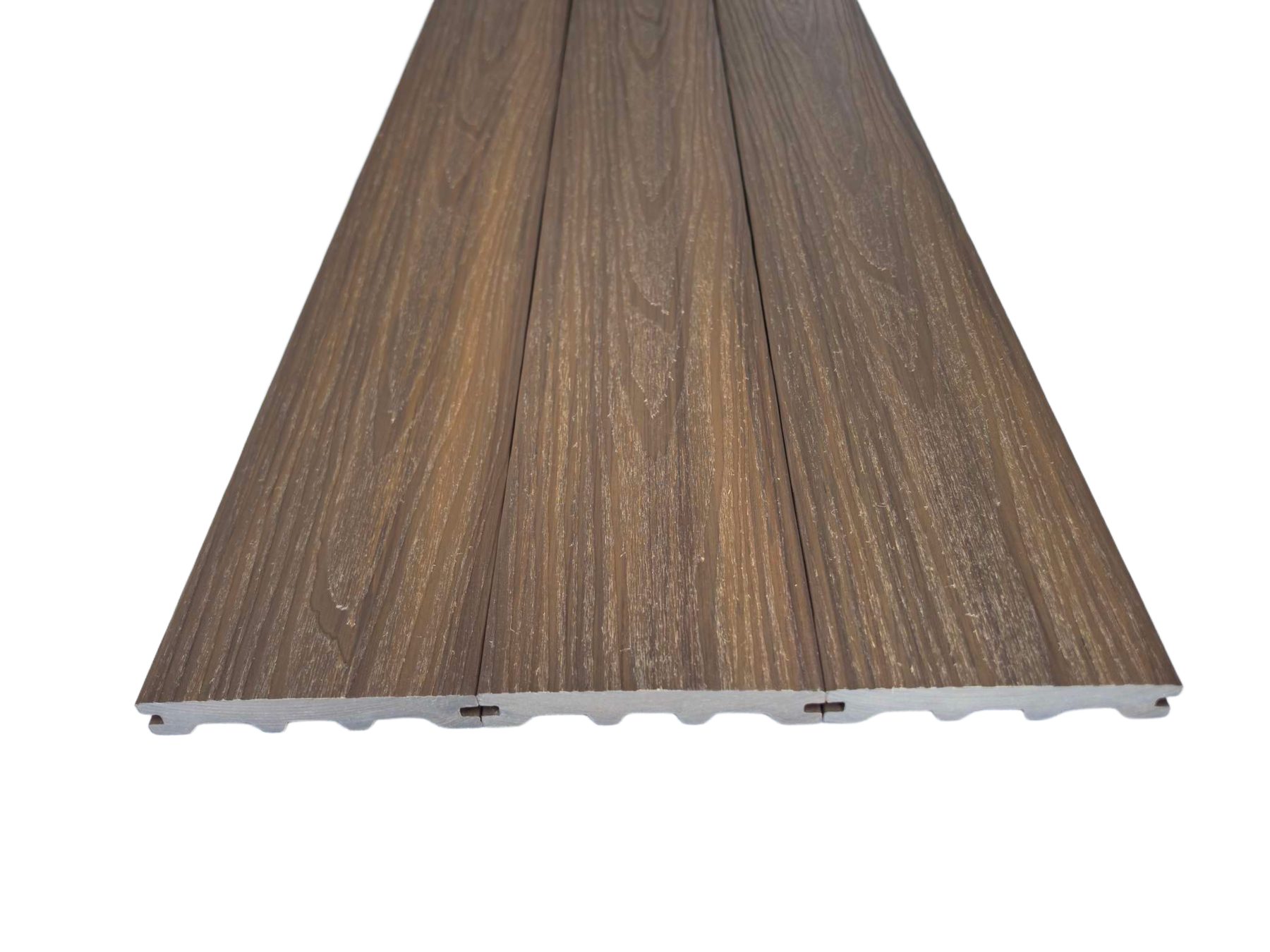
One 16 ft board covers 8 sq ft of deck. Capped composite in a single Walnut finish, grooved on both edges for hidden fasteners — a walking surface with no screw heads in it, and nothing to stain or seal once it is down.
A protective cap is bonded over the composite core, which is what keeps the color from washing out and the surface from splintering. It resists fading, stains, moisture, mold, mildew, and insects — the failure modes that put a wood deck on a maintenance schedule.
One board, one color, one length — Walnut, in 16 ft lengths, sold individually rather than by the bundle, so you buy exactly what the frame takes.
Coverage is calculated at the nominal 6″ width; a finished deck with standard gapping between boards will cover slightly less, which is what the waste factor in the calculator below accounts for. 9.75% CA tax added at checkout. Building something large? Send us the square footage through the chat for a project quote.
Enter the deck footprint and we’ll estimate boards plus tax. Framing, clips, and fascia are quoted separately — tell us the layout and we’ll work those out with you.
Boards only. Framing, hidden fastener clips, and fascia are quoted separately.
Request a written quoteA wood deck in Southern California asks for a sanding and a coat of stain every year or two, and it still greys, splinters, and cups. The capped composite board is engineered around exactly those failures.
The cap seals the core, so the surface never opens up into splinters the way a sun-baked wood board does. It matters most where people walk barefoot — pool decks, spa surrounds, rooftop terraces.
UV protection is built into the capped surface rather than brushed on top of it, so the Walnut grain keeps its depth instead of fading to uniform grey over a couple of summers.
No sanding, staining, sealing, or painting. Sweep it, rinse it, and move on — the maintenance budget a wood deck quietly assumes simply is not there.
Both edges are grooved for hidden fastener clips, so the boards are held from the side. No screw heads, no plugs, and no row of rust spots two winters later.
The composite does not feed mold or termites and will not rot at the joist line, which is where wood decks usually fail first and most expensively.
Reclaimed wood fiber and recycled polymer, the same material family as our cladding and fence lines — so a deck, a screen wall, and a fence can be matched from one supplier.
Decking pairs with our WPC cladding boards for screen walls and skirting, and with fence panels and gates to close in a yard. Tell us the whole project and we’ll quote it as one.
Boards are on the floor in Chatsworth rather than three weeks out on a special order, so a deck can be measured on Saturday and loaded on Monday.
We sell deck boards factory-direct to homeowners and contractors across Los Angeles — Chatsworth, Porter Ranch, Northridge, Woodland Hills, Glendale, and Burbank, out to Santa Monica and the wider Valley. Pickup is free by appointment; local delivery is quoted per job within about 60 miles.
Weighing the options first? Our WPC vs Trex vs wood comparison covers how capped composite ages against brand-name decking and natural wood, and the 2026 Los Angeles cost guide sets material cost against a fully installed job.
We keep boards on the showroom floor so you can feel the texture and see the grain at full length before committing to a deck’s worth. Bring your dimensions and your contractor.
Book a visitDeck boards are $35.36 per 16 ft board — the same price as our 108″ cladding board — which is about $4.42 per square foot in material, since each board covers 8 sq ft (6″ wide × 16 ft long). Installed composite decking in Los Angeles typically runs $30 to $60 per square foot, so buying boards direct is where most of the saving sits. See our Los Angeles cost guide for the wider comparison.
Each board is 1″ thick, 6″ wide, and 16 ft long — 8 sq ft of coverage per board — grooved on both edges so it takes hidden fastener clips. Decking comes in a single color, Walnut, a mid-tone brown with multi-tone grain. Boards are sold individually, not by the bundle.
The grooved edge is made for hidden fastener clips, which hold each board from the side and leave the walking surface free of screw heads. Clips are ordered separately — tell us your board count and joist spacing and we’ll work out how many you need.
Plan on 16″ on center for a residential deck laid straight, and 12″ on center for a diagonal layout or for stair treads. Confirm against your local code and inspector before you frame — we can’t sign off on a structural detail for you.
The capped surface is textured for slip resistance and stays splinter-free. Like any composite decking, Walnut is a mid-tone brown and will pick up heat in direct Southern California sun, so plan on shade or footwear for a pool deck or rooftop terrace at midday.
In-stock boards are ready for same-day or next-day pickup by appointment at our Chatsworth showroom. At 16 ft, boards need a truck, trailer, or roof rack — worth planning before you drive over. Local delivery is quoted per job within about 60 miles, covering Los Angeles, Santa Monica, the San Fernando Valley, and surrounding areas.
Both are capped wood-plastic composites, and both resist rot, insects, and fading. The difference is price and availability — our boards are stocked factory-direct at $35.36 per 16 ft board (about $4.42 per sq ft), where brand-name decking carries retail markup and is often special-order. The trade-off is color: we stock Walnut only. Full side-by-side in our WPC vs Trex vs wood comparison.